
Six Signs Your Solar Panels Aren't Pulling Their Weight
Published July 20, 2026 by C
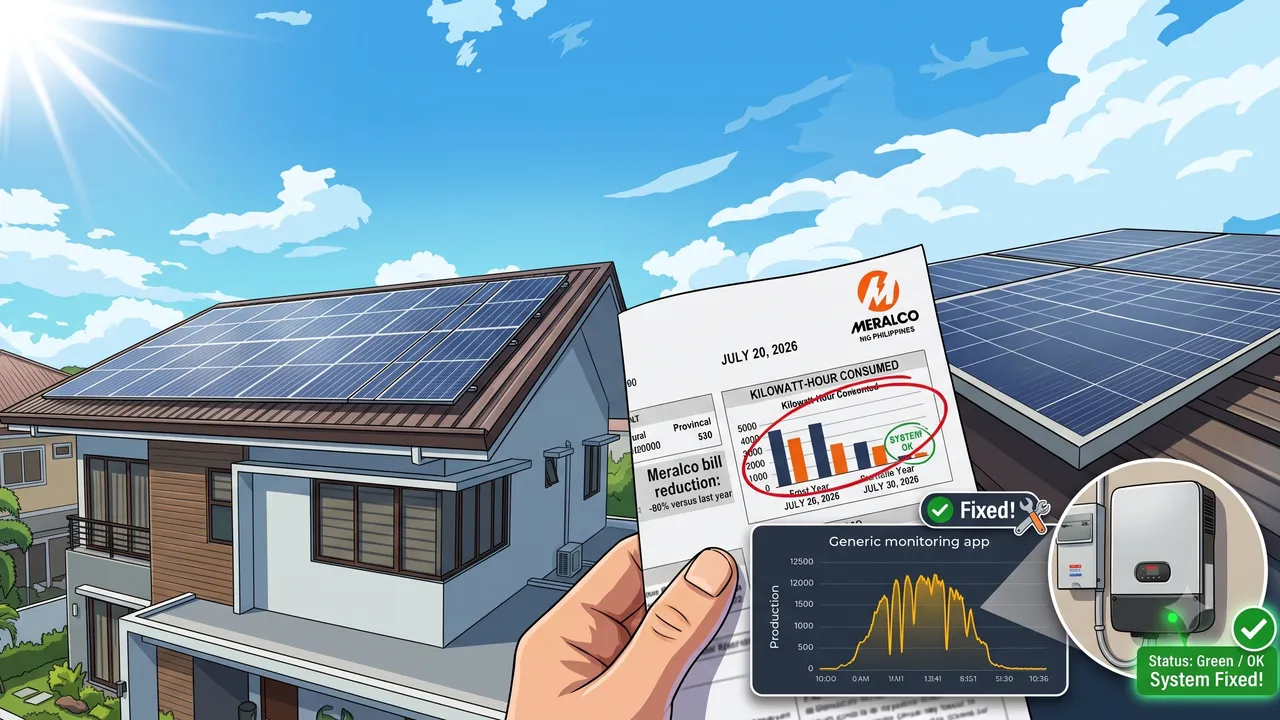
Solar panels fail quietly. No warning light on your ceiling, no sound, no smell. The system just produces less than it should, month after month, while you keep paying Meralco for the difference. At this month's rate of ₱14.83 per kilowatt-hour, every kWh your panels should have produced but didn't is a kWh you bought at one of the highest residential prices in Southeast Asia.
The good news: an underperforming system almost always leaves evidence. You just have to know where to look. Here are six places, ordered from easiest to check.
1. Your Meralco bill is creeping back up
Your bill is the monitoring app you already have. But read it correctly: compare kilowatt-hours, not pesos. Rates have risen sharply this year, so a higher peso total might just be Meralco's pricing. If the kWh you're drawing from the grid is climbing back toward what you consumed before solar, and your household habits haven't changed, your system is producing less than it used to.
Check the same month against last year, not last month. December production will always trail April's — that's weather, not damage.
2. Your net metering credits are shrinking
If you're enrolled in net metering, your bill shows credits for the excess power you export. Those credits shrinking over several billing cycles, with no change in how you use electricity at home, means less excess is leaving your roof. Either you're consuming more or producing less, and the kWh comparison from sign #1 tells you which.
3. The inverter is trying to tell you something
The inverter is the box that converts your panels' output into power your home can use, and it's usually the first component in the system to have problems. It's also the only one with a voice: status lights and, on most models, an error code on its display or app.
Walk past it once a week. Green light, no drama. A red or orange light, a blinking pattern you haven't seen before, or an error code is your cue to photograph the display and send it to your installer. Don't open the unit yourself — there's nothing user-serviceable inside, and plenty that bites.
4. The monitoring app shows a cliff, not a slope
If your system came with production monitoring, look at the shape of the data, not today's number. Output that declines gently across seasons is normal. A sudden drop that persists through sunny days is not — it points to a failed panel string, a tripped breaker, or an inverter fault. Zero production on a clear day means the system is down entirely, and it's remarkable how long that can go unnoticed in a house where the lights still turn on. The grid picks up the load without ceremony; only the bill records it.
5. Something looks different on the roof
After every typhoon, do a ground-level inspection. From the ground means from the ground, with your phone camera zoomed in. You're looking for cracked or discolored panels, debris sitting on the array, panels that look shifted or lifted at a corner, and new shading: the neighbor's mango tree grew, someone built an extension, a new water tank went up next door. Shade on even one panel can drag down a whole string's output, which is why a small change casts a long shadow on your production numbers.
Leave the roof itself to people paid and insured to be there.
6. Dust and grime you can see from the street
In dry months, dust builds up; near roads, it builds faster. A visible film on the glass is production quietly lost. Rain handles much of it, but if the panels look dirty from the street, they're dirtier up close. Cleaning is an installer-visit job or, at most, a gentle rinse from ground level — never pressure washers, never abrasives, never your weight on the panels.
What a good installer should be doing about all this
Here's the part worth knowing even if you don't own panels yet: none of the checks above should fall entirely on you. A solid installation comes with after-sales support. That means a warranty covering panels, inverter, and workmanship separately, a response commitment when you report a fault, and ideally a periodic inspection. When you compare installers, ask what happens after the handover, and get it in writing. The answer tells you more about an outfit than any brochure.
Your panels can't speak. Your bill speaks for them, every month, at ₱14.83 a word. Learn to read it, and follow the blog for more of this. We publish what we'd want to know before and after going solar.
Sources: Meralco advisory, "Higher Residential Rates this July 2026" (rate figure). The diagnostic guidance above is qualitative and general-practice; the Philippines has no official residential solar performance data. Regional price comparison per Ember/Bloomberg reporting, July 2026.
Stay updated on PH solar
Get new guides, updated cost data, and free tool alerts - straight to your inbox.
Already ready to compare installers?
We use the details you submit only to follow up with installer options. See our Privacy Policy.