
Net Metering Philippines: 2026 Rules & Application Guide
What is net metering? Net metering is a billing mechanism that credits solar energy system owners for the electricity they add to the grid. If your solar panels generate more power than you use during the day, the excess is exported to your distribution utility, earning peso credits that reduce your next electricity bill.
Published April 24, 2026
Making Sense of Net Metering in the Philippines
Meralco’s residential rate — check their latest rate advisory for the current figure — consistently runs among the highest in Southeast Asia for residential customers. For a household running air conditioners through the Philippine dry season, that number is not an abstraction. It shows up in full on the bill at the end of the month, with no warning and no room to negotiate.
Property owners look at their roofs baking in the sun and realize they are sitting on an untapped energy asset. But capturing that solar energy is only half the equation. The other half is ensuring the power you generate translates into measurable financial relief on your monthly utility statement. There is a specific regulatory mechanism built into Philippine law designed to cushion this exact blow for solar owners.
The Law and the Mechanics
Adopting solar power fundamentally transforms your relationship with your local distribution utility. You shift from being a pure consumer into a “prosumer.” You consume energy from the grid when your house demands it, and you produce energy for the grid when your panels generate a surplus.
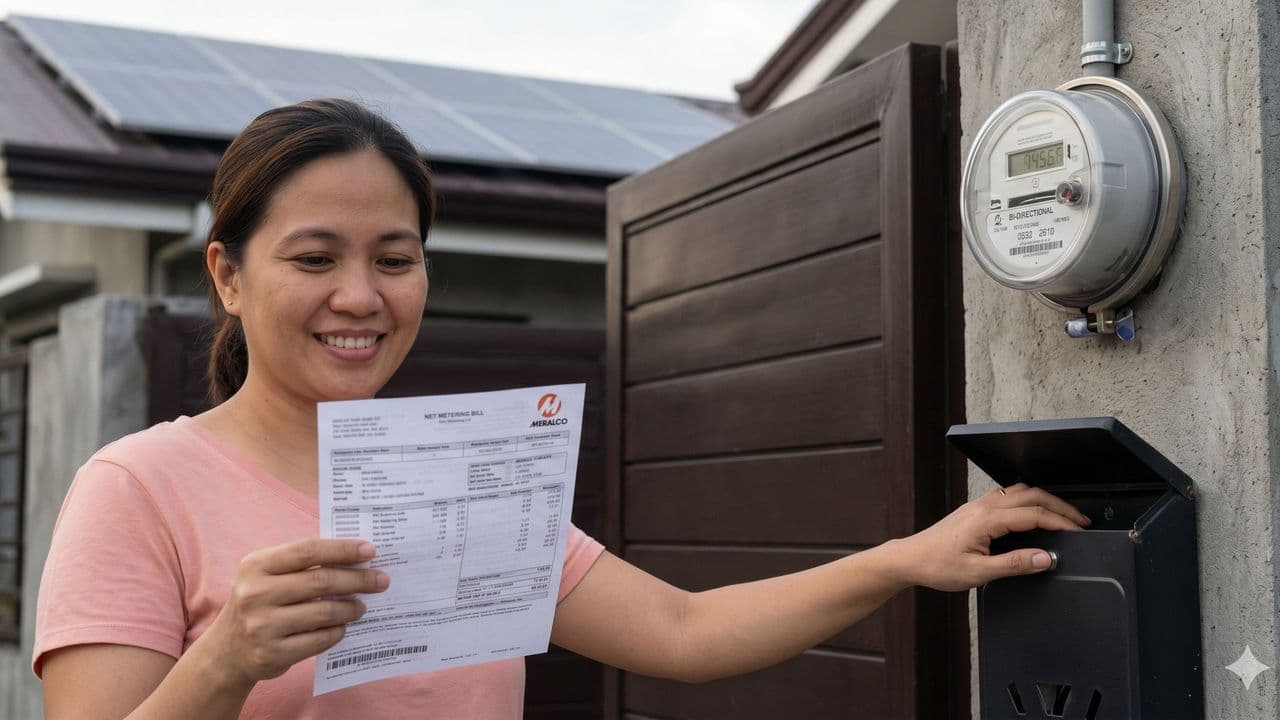
This operational framework draws its primary legal authority from Section 10 of Republic Act No. 9513, widely known as the Renewable Energy Act of 2008. The law requires local utility companies to offer this exact billing mechanism to qualified end-users. The entire system pivots on a single piece of hardware: the bi-directional meter. A standard analog or digital meter only ticks forward as you pull power from utility lines. A bi-directional meter actively measures both the electricity you import from the grid and the excess solar electricity you export back into it.
Under the ERC net metering rules, the raw electricity you send back is converted into peso credits. These credits appear directly on your printed or digital monthly bill as a clear deduction. If you manage to export more value than you import within a single billing cycle, those credits do not disappear. They simply roll over to the next month. This rollover system acts as a financial buffer, allowing you to bank credits during the sunny dry season to help offset your consumption during the rainy months.
The Executive Order 110 Mandate
Bureaucratic friction and administrative delays have historically frustrated homeowners trying to formally connect their solar systems to the grid. Paperwork would sit on desks for months. Executive Order No. 110, Series of 2026, signed by President Marcos in response to critical grid constraints, addressed this directly. Under this order, the Department of Energy mandated that net metering applications be processed within 10 working days. This directive significantly reduced the waiting period that previously slowed grid connection for new solar owners.
Who Qualifies for the Program?
Not every solar setup is legally eligible to participate in this framework. The primary regulatory restriction revolves around total system capacity. Your solar installation must have a maximum capacity of 100 kilowatts (kW) or less. For context, a standard Philippine residential solar setup ranges from 3 kW to 10 kW. Even sprawling properties and small commercial establishments easily fit well within the 100 kW ceiling.
You must also be an active, registered customer of a recognized distribution utility. This includes major providers like Meralco in Metro Manila and surrounding provinces, the Visayan Electric Company (VECO) in Cebu, or the Davao Light and Power Company (DLPC) in Mindanao. Your internal electrical setup needs to be either a grid-tied or a hybrid solar system. Off-grid systems operate entirely independent of the utility network. Because off-grid setups have no physical connection to local power lines, they cannot export power and do not participate in this billing arrangement.
Putting It in Peso Terms
Understanding the raw numbers clarifies the tangible value of the program. Meralco publishes a rate advisory each month — check their website for the current residential rate, which has historically ranged between ₱12 and ₱15 per kWh in recent years. When you export excess solar power, the utility does not buy it back at that full retail price. Instead, they credit you based on their blended generation cost. This export rate varies monthly based on global fuel prices and supplier contracts and is generally lower than the full retail rate.
Consider the Reyes family living in a three-bedroom home in Quezon City. They operate a 5 kW grid-tied solar system. Both parents work at an office in Makati, and their children attend school during the weekdays. The house sits mostly empty from 8:00 AM to 5:00 PM. During these prime daylight hours, their roof receives uninterrupted sunlight, generating substantial power. Since the household consumption is very low during the day — running only a refrigerator and a few standby appliances — most of that clean energy flows directly backward through the meter and into the Meralco grid.
By the end of the billing cycle, the Reyes family exported 350 kWh of electricity. Using an illustrative generation charge of around ₱7.00 per kWh — the actual export rate fluctuates monthly, so check your utility’s current advisory — they earn roughly ₱2,450 in direct peso credits. When Meralco calculates their evening and weekend electricity usage at the prevailing retail rate, that ₱2,450 is deducted straight from their final total. They effectively turn unused daytime sunlight into reliable evening savings.
The Application Process Step-by-Step
Securing approval requires strict coordination between your chosen contractor, your local government unit (LGU), and your utility provider.
Step 1: Partner with a DOE-Accredited Installer
Your solar provider serves as your technical guide through the rigorous requirements. Choose an installer officially accredited by the Department of Energy. Accreditation ensures their engineering practices meet national safety standards. The installer will prepare the single-line diagram and the detailed electrical plans necessary for local building permits.
Step 2: Secure the CFEI from your LGU
You cannot legally connect any power-generating equipment to the public grid without a Certificate of Final Electrical Inspection (CFEI). Coordinate with your DOE-accredited installer to submit your signed and sealed engineering plans to your city or municipal engineering office. The LGU electrical inspector must visit your property to verify the physical installation complies with the Philippine Electrical Code.
Step 3: Undergo the Distribution Impact Study
Submit your formal application alongside the secured CFEI to your utility provider. The utility will then conduct a Distribution Impact Study (DIS). This engineering assessment determines if the neighborhood transformers and local power lines can safely handle the electricity your specific system will inject. For typical residential sizes, this study is a standard routine check.
Step 4: Sign the Net Metering Agreement
Once the DIS is cleared and technical compatibility is confirmed, the utility will draft a Net Metering Agreement (NMA). This legally binding contract outlines your responsibilities as a generator and the utility’s obligations regarding your energy credits. Review the stipulations carefully and sign the document to formalize your prosumer status.
Step 5: Bi-Directional Meter Installation
The final physical step is the commissioning phase. The utility will dispatch authorized technicians to pull out your old meter and install a new bi-directional digital unit. They will conduct live tests on your inverter’s safety features. The administrative handling of this final connection phase falls firmly under the mandated 10 working day processing window. Once the technicians flip the breaker and seal the meter, you officially start accumulating credits.
Clearing Up Common Misconceptions
Homeowners frequently hear secondhand stories about solar credits that warp their understanding of how the mechanics actually operate. Clarifying these points ensures you set the right financial expectations before signing an installation contract.
A frequent assumption is that your utility company will write you a physical check or send cash to your bank account at the end of the month if you generate a large surplus of power. It is easy to see why people expect this. The phrase “selling power back to the grid” strongly implies a direct cash transaction. In reality, the utility issues peso credits that remain locked strictly within your billing account. If your solar credits exceed your household usage for a specific month, no money changes hands. The surplus simply rolls forward to your next bill, waiting to be consumed when your air conditioning usage spikes.
Another widespread belief is that you must purchase expensive lithium batteries to qualify for the program. This confusion stems from mixing up the requirements for off-grid living with grid-tied regulations. You do not need a single battery to participate. A standard grid-tied inverter simply takes the direct current from your roof panels, converts it to alternating current, and pushes the surplus straight into the utility lines. Using the scale of the public grid as your virtual battery is the entire foundational concept of the program.
Frequently Asked Questions
Frequently Asked Questions
How long do net metering credits last?
Under the ERC’s amended net metering framework, your earned peso credits roll over indefinitely from month to month. They do not expire at the end of the calendar year and remain permanently on your account as a deduction against your future electricity consumption.
Can commercial buildings apply for net metering?
Yes. Small businesses, warehouses, and commercial buildings can apply, provided their total installed solar capacity remains at 100 kW or less. Facilities requiring systems larger than 100 kW must explore different regulatory frameworks, such as the Green Energy Option Program (GEOP).
Do I need to change my current electricity meter?
Your local distribution utility must replace your existing analog or standard digital meter with a specialized bi-directional meter. Your current equipment can only measure incoming electricity, whereas the new unit accurately tracks both the power you import and the power you export.
Is net metering available outside Metro Manila?
Yes. Republic Act No. 9513 mandates that all distribution utilities and electric cooperatives across the entire Philippines must offer this program to qualified end-users operating within their designated franchise areas.
Does the 100 kW limit apply to my roof size or my inverter capacity?
The 100 kW regulatory cap applies strictly to the alternating current (AC) nameplate capacity of your solar inverter. It does not limit the physical dimensions of your roof or the combined direct current (DC) wattage of the solar panels themselves.
What happens if my solar panels produce less power than my house uses?
Your home draws the required energy shortfall directly from the distribution utility grid. You simply pay for that imported grid electricity at the standard retail rate, with your earned solar credits automatically offsetting a portion of that cost.
Thinking about going solar and earning net metering credits? Solar Scout Philippines can show you exactly how much you could save based on your actual monthly bill, your location, and your roof. No guesswork, no pressure — just honest numbers to help you decide.
[Get your free solar estimate at Solar Scout Philippines →]
Sources
• Meralco Latest Residential Rate Advisory
• Republic Act No. 9513 (Renewable Energy Act of 2008)
• Executive Order No. 110, s. 2026 (Official Gazette)
• Department of Energy Net Metering Directives under EO 110
• Eco-Business reporting on Philippine solar energy development
• Rappler reporting on Philippine energy regulations
Stay updated on PH solar
Get new guides, updated cost data, and free tool alerts - straight to your inbox.
Already ready to compare installers?
We use the details you submit only to follow up with installer options. See our Privacy Policy.