
How Solar Works in the Philippines: From Sunlight to Savings
Your July Meralco bill charges you ₱14.83 per kilowatt-hour. That's the second increase in two months, driven by the Middle East conflict, a weak peso, and record demand on the Luzon grid. Every time a supply chain buckles or a plant trips, the shock lands on your bill within weeks, and you have no power to negotiate it.
Published April 19, 2026
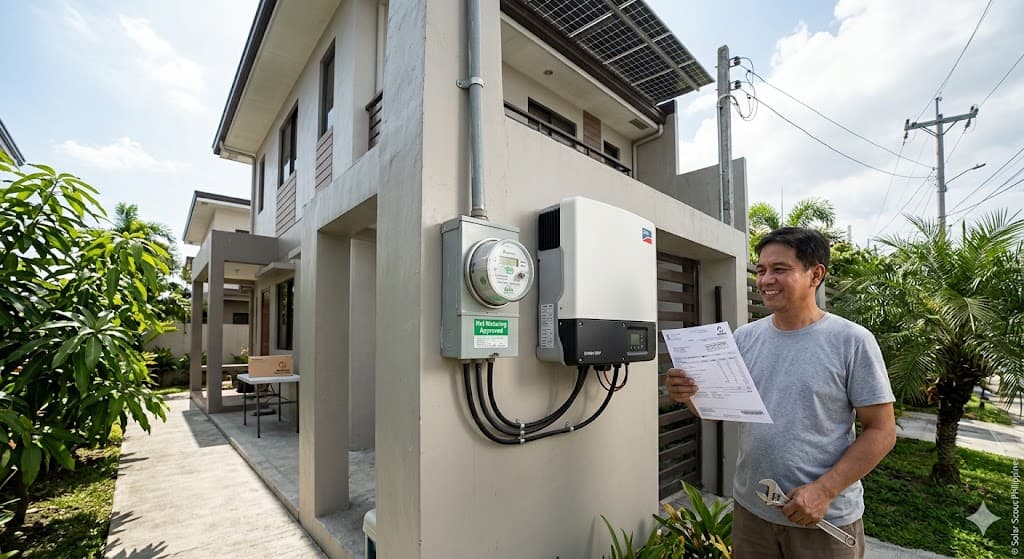
A family in Taytay, Rizal running two bedroom aircons through the dry season knows exactly what that feels like. So does a bakery owner in Metro Cebu watching ovens eat the margins. Renting your electricity forever is a losing game, and that reality is pushing thousands of Filipino property owners to look up at their roofs and see an unused asset.
The catch: the local market is flooded with jargon, aggressive sales tactics, and conflicting advice about batteries. Here is how a solar setup actually works in the Philippines in 2026, what the new emergency-era rules changed, and what the savings look like when you run the numbers honestly.
The Anatomy of a Philippine Solar Setup
A residential solar setup is a small network of components working together to catch sunlight and route it safely into your breaker panel.
Solar Panels (The Collectors)
Think of solar panels as energy sponges. Made of silicon photovoltaic cells, they sit anchored to your roof and absorb photons from sunlight, generating direct current (DC) electricity. Modern Tier 1 panels perform best under direct sun. Heavy cloud cover during monsoon season temporarily drops their daily yield, but they keep producing a baseline of usable power from ambient daylight.
The Inverter (The Translator)
Your appliances can't use raw DC. Everything from your refrigerator to your laptop charger runs on alternating current (AC), and the inverter bridges that gap. Mounted near your main breaker, it converts DC from the roof into stable AC power, monitors system health, and decides where each watt goes at any given moment. It is the brain of the operation.
The Bi-Directional Meter (The Accountant)
If you stay connected to a distribution utility like Meralco, VECO, or Davao Light, your standard meter gets replaced with a bi-directional one. A traditional meter only counts what you buy. A bi-directional meter counts both directions: the power you pull from the grid at night, and the excess solar you push back into it on a bright afternoon. Your utility charges you the cost difference for the new meter, so ask for the current fee in writing before you sign your net-metering agreement.
Grid-Tied, Hybrid, or Off-Grid: What Makes Sense Here?
The biggest architectural decision is how your system interacts with the grid. There are three options.
Grid-Tied
A grid-tied system connects directly to your utility with no batteries. Your home runs on solar during the day, exports any surplus to the street grid, and pulls from the utility at night. Without the cost of lithium batteries, it delivers the fastest payback, which is why it remains the most popular choice in urban areas.
The drawback is functional. During a brownout, a grid-tied system shuts down automatically. This mandatory safety feature, called anti-islanding, stops your panels from sending live voltage into street lines while linemen are making repairs.
Hybrid
A hybrid system adds a battery bank. Excess morning power charges the batteries first; once they're full, the remaining surplus exports to the grid. When a typhoon or red alert knocks out the grid, the hybrid inverter isolates your home and switches to battery power. Lights, fans, and internet stay on.
The trade-off is financial. Quality lithium iron phosphate (LiFePO4) batteries are expensive and typically need replacement every seven to ten years, which pushes your break-even point further out. Hybrids make the most sense in provinces with unstable power, if the budget allows.
Off-Grid
For properties with no utility connection at all, such as remote farms or island resorts, off-grid is the only option. These systems must supply 100 percent of the property's power from oversized solar arrays and large battery banks, usually with a backup diesel generator for consecutive rainy days. It is the most expensive architecture by far.
How Net Metering Actually Pays You
Generating power is half the equation. The financial leverage comes from the national net metering program under Republic Act No. 9513, the Renewable Energy Act of 2008, which lets ordinary consumers become micro-generators. When your panels overproduce, the surplus flows out through your bi-directional meter and your utility credits you in pesos against your next bill.
Two rule changes made this meaningfully better.
Credits Now Roll Over Indefinitely
Under ERC Resolution No. 15, Series of 2025, unused net-metering credits bank and roll over across current and future billing periods instead of expiring. If you sell your property, the credits can even transfer to the new owner with a conforme letter.
Picture a bright April week when your family travels for Holy Week and the aircon stays off. Your system exports heavily and you bank the credits. Come December, with shorter days and evening parties running the lights, those April credits offset your bill.
The REC Meter Is Now Optional
The same ERC resolution made the Renewable Energy Certificate (REC) meter voluntary. Utilities previously required a second physical meter just to measure gross generation. Now you can waive it by submitting an affidavit, and your generation gets computed using an ERC-prescribed formula instead. One less piece of hardware to pay for at installation.
The Catch Nobody Explains: Use It Before You Sell It
Here is the part most solar content skips. Exported power is credited at your utility's blended generation rate, roughly the generation charge on your bill (about ₱9.25 per kWh on Meralco's July 2026 rates). Power you consume directly from your own panels offsets the full retail rate of about ₱14.83 per kWh.
In plain terms: a self-used kilowatt-hour is worth about 60 percent more than an exported one. Run your washing machine, aircon, and water heater during daylight hours and you squeeze significantly more value out of the same panels. Net metering is the safety net for your surplus, not the main prize.
The Financial Reality: Costs and Payback
A standard 5-kilowatt-peak (kWp) grid-tied system can comfortably run two 1.5 HP inverter aircons, a large refrigerator, and household electronics simultaneously during daylight. As of 2026, installers typically quote between ₱200,000 and ₱280,000 for this size, depending on equipment brands and workmanship. [Confirm against your latest installer survey data before publishing.]
The savings math, done honestly: a 5kWp system in Luzon produces roughly 550 to 650 kWh per month. If most of that offsets daytime consumption at retail rates and the rest exports at the generation rate, a household with a large bill can realistically cut ₱7,000 to ₱9,000 per month. At ₱8,000 monthly, a ₱250,000 system pays for itself in around 2.6 years. Tier 1 panels carry 25-year performance warranties, so everything after break-even is two decades of heavily discounted daytime electricity, minus minor maintenance.
Your actual numbers depend on your consumption pattern, roof orientation, and utility rates. Run your own figures with our ROI Calculator before talking to any installer.
The Paperwork Just Got a Deadline
Mounting panels takes two to three days. The paperwork used to take months, and often did: utility approvals routinely stretched past 45 days with no legal deadline forcing a response.
That changed in April 2026. Following the declaration of a national energy emergency under Executive Order No. 110, the Department of Energy issued Department Circular DC2026-01-00012, which puts the entire approval chain on a clock:
- Your LGU must issue the electrical permit within 3 working days.
- Your LGU must issue the Certificate of Final Electrical Inspection (CFEI) within 7 working days.
- Your distribution utility must process a complete net-metering application within 10 working days, down from 20.
- If the utility misses the deadline, a "deemed approval" mechanism treats your application as approved.
The process still starts with your installer coordinating a Distribution Impact Study, which confirms your street transformer can safely absorb the power you plan to export. But the era of applications sitting in a drawer for two months is legally over. One practical note: the LGU deadlines cover processing time, while scheduling the physical inspection still depends on your city hall's capacity, so it remains the least predictable step.
The DOE also lifted the net-metering capacity cap for commercial and industrial consumers from 100 kW to 1 MW in the same 2026 reforms, which turns previously marginal commercial rooftop projects into viable ones. If you run that bakery in Cebu, the rules now work in your favor too.
Frequently Asked Questions
Will my panels work during a Meralco brownout?
Only with a hybrid system and battery bank. A standard grid-tied system shuts down during outages to protect linemen working on the grid.
How long does the net-metering application take now?
Under DOE Department Circular DC2026-01-00012 (April 2026), your utility must process a complete application within 10 working days, your LGU must issue the electrical permit within 3, and the CFEI within 7. Budget extra time for the inspection appointment itself, which varies by municipality.
Are solar panels safe during typhoons?
Yes, if engineered and installed correctly. Quality panels are tested against severe wind loads. The failure point in a storm is rarely the glass; it's cheap mounting. Insist on heavy-duty anodized aluminum rails fastened to your roof trusses, not just the outer roofing sheet.
Do I need to clean my panels constantly?
Monsoon rains do most of the work. During the long dry season, urban smog and dust buildup can cut efficiency by 5 to 10 percent, so hose them down every few months, early morning or late afternoon when the glass is cool.
How much roof space do I need?
A 5kWp system uses 10 to 12 panels, roughly 25 to 30 square meters of unshaded roof. South-facing is technically ideal, but east and west-facing roofs perform very well this close to the equator.
Do I need HOA approval?
In most gated subdivisions, yes. Submit your installer's engineering plans to the HOA or property management office before installation starts. Clearing this early prevents costly redesigns.
The net metering clock now runs in your favor. With utilities legally bound to a 10-working-day window, a system you commission this month could be earning credits before your next billing cycle closes. If you want to know what that looks like in actual pesos for your home, Solar Scout Philippines can show you. No installer pressure, no jargon. Just an honest estimate based on your roof, your bill, and your location.
Get your free solar estimate at Solar Scout Philippines →
Sources
- Official Gazette: Executive Order No. 110, s. 2026 — https://www.officialgazette.gov.ph/2026/03/24/executive-order-no-110-s-2026/
- Philippine News Agency: PBBM declares state of nat'l energy emergency — https://www.pna.gov.ph/articles/1271702
- ERC Resolution No. 15, s. 2025 (Amended Net-Metering Rules) — coverage: Philstar (https://www.philstar.com/business/2025/09/03/2469969/erc-fuels-re-growth-net-metering-reforms), pv magazine (https://www.pv-magazine.com/2025/09/15/philippines-updates-net-metering-rules-to-ease-adoption-for-17000-users/)
- Philstar: DOE speeds up net metering process (10-working-day mandate, 3-day LGU permits) — https://www.philstar.com/business/2026/04/05/2518672/doe-speeds-net-metering-process
- SolarQuarter: Philippines DOE Mandates 10-Day Net Metering Approvals Under Energy Emergency — https://solarquarter.com/2026/04/01/philippines-doe-mandates-10-day-net-metering-approvals-under-energy-emergency-to-accelerate-rooftop-solar-adoption-and-reduce-power-costs/
- Meralco: Higher Residential Rates this July 2026 (₱14.8261/kWh; generation charge ₱9.2504/kWh) — https://company.meralco.com.ph/news-and-advisories/higher-residential-rates-july-2026
- Republic Act No. 9513 (Renewable Energy Act of 2008)
Stay updated on PH solar
Get new guides, updated cost data, and free tool alerts - straight to your inbox.
Already ready to compare installers?
We use the details you submit only to follow up with installer options. See our Privacy Policy.